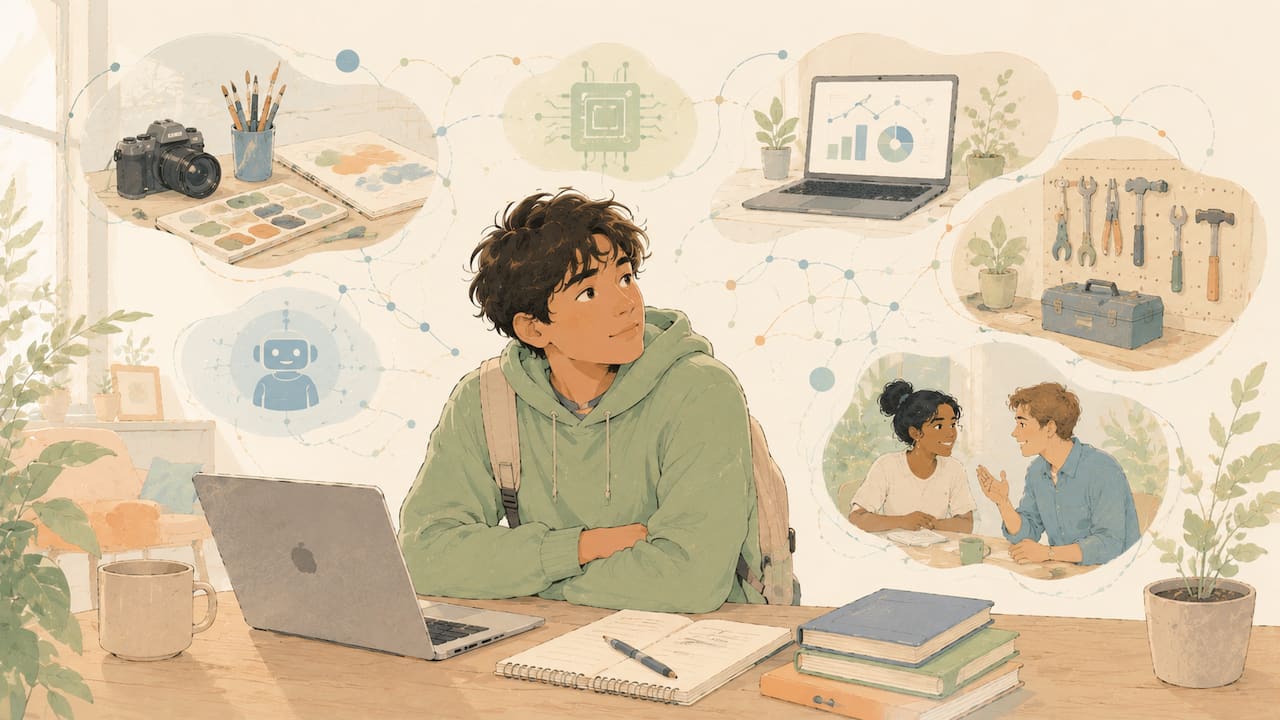
AI is everywhere right now. It is in your phone, your school, your workplace, and your feed. So if you have caught yourself thinking, *Will AI take my job?*, you are not being dramatic. You are paying attention.
But here is the calmer truth.
AI will change work, and it will change some jobs a lot.
It is also going to create new roles, new pathways, and new ways to get started, especially for young people who learn how to work with it.
This guide is UK-first, practical, and human. No scare tactics, no hype. Just what is happening, what it means for entry-level work, and what you can do next.
What AI can, and cannot, do
AI is brilliant at patterns. It can scan, sort, summarise, and generate content quickly. That is why it is being used for admin, customer support, basic marketing, and data tasks.
But AI is not a person. It does not truly understand context, care about outcomes, or build trust. It cannot replace the human parts of work that make teams work.
AI struggles most with:
- Real-world judgement when the answer is not obvious
- Empathy, reassurance, and emotional nuance
- Responsibility and accountability
- Relationship-building and influence
- Creativity that comes from lived experience
If a job is mostly repetitive, screen-based, and rules-driven, it is more likely to be automated. If a job is people-based, messy, hands-on, or requires judgement, it is harder to replace.
The part nobody says out loud, entry-level work is tightening
A lot of entry-level jobs include tasks that AI can now help with. That means some employers are experimenting with smaller teams, fewer junior hires, or different job designs.
For young people, that can feel unfair. You need experience to get a job, but you need a job to get experience.
The opportunity is to get ahead of that curve by building the skills that make you useful in a modern workplace.
So, will AI take your job?
A better question is, *Which parts of my future job could AI do, and which parts need a human?*
Most roles will not disappear overnight. They will change. Your advantage is learning to:
- Use AI for the boring bits
- Build human skills that make you trusted
- Show evidence of what you can do
What young people can do next (simple, not overwhelming)
1) Build a “proof of skills” folder
You do not need a perfect CV to show potential. Start collecting:
- Short projects (a poster, a spreadsheet, a simple website, a video)
- Before and after improvements (what you changed, what happened)
- Screenshots, links, and reflections
2) Learn AI like a tool, not a personality
AI is like a power tool. Useful, but it needs a human holding it.
Try:
- Summarising a long article into 5 bullet points
- Drafting an email, then rewriting it in your own voice
- Planning a revision schedule, then adjusting it to your real life
3) Strengthen your human advantage
Pick one human skill to practise for 30 days:
- Communication: explain something clearly
- Reliability: show up, follow through
- Teamwork: help someone else succeed
- Confidence: ask better questions
4) Get closer to real workplaces
Experience does not have to mean a paid job on day one.
Look for:
- Work experience, volunteering, shadowing
- Community projects
- Helping a local business for a week
For parents and educators, how to support without panic
You do not need to become an AI expert.
The best support is:
- Curiosity, not fear
- Helping them build confidence through small wins
- Encouraging real-world exposure to different industries
Good questions to ask:
- What do you enjoy doing that helps other people?
- When do you feel most capable?
- What problems do you like solving?
- What kind of environment helps you thrive?
The bottom line
AI will change work. That is real. But your future is not only about competing with a machine. It is about becoming the kind of human people want to work with.