Research
Tomorrow’s Jobs Today: Skills You’ll Need (and Where to Get Them)
8 January 2026
Written by: inyourroots® Research Team
Young people deserve clearer routes into fast-changing industries
The world of work is changing quickly. Not just the job titles, but the tasks inside jobs.
That can feel exciting. It can also feel like trying to step onto a moving train.
If you’re 16–25, you’re often expected to make “big” career choices while:
- Industries are shifting fast (AI, green energy, new creative tech)
- Entry routes are not always obvious
- Money pressure makes every decision feel higher-stakes
This piece breaks down what is changing, what skills are showing up again and again, and where you can start building them without needing to have your whole future mapped out.
Why this feels hard right now (it’s not just you)
In UK research on young people’s mental health, 48.2% of 17–25 year olds said they were worried about money. When money is tight, career decisions can feel less like exploration and more like survival.
That is why clear pathways matter. You deserve signposting that turns “future skills” into practical next steps.
The shift: stop chasing one perfect job title
A useful way to think about the future is this:
- Job titles change
- Skills travel
Instead of trying to pick one forever-job, build a skills toolkit you can carry across roles.
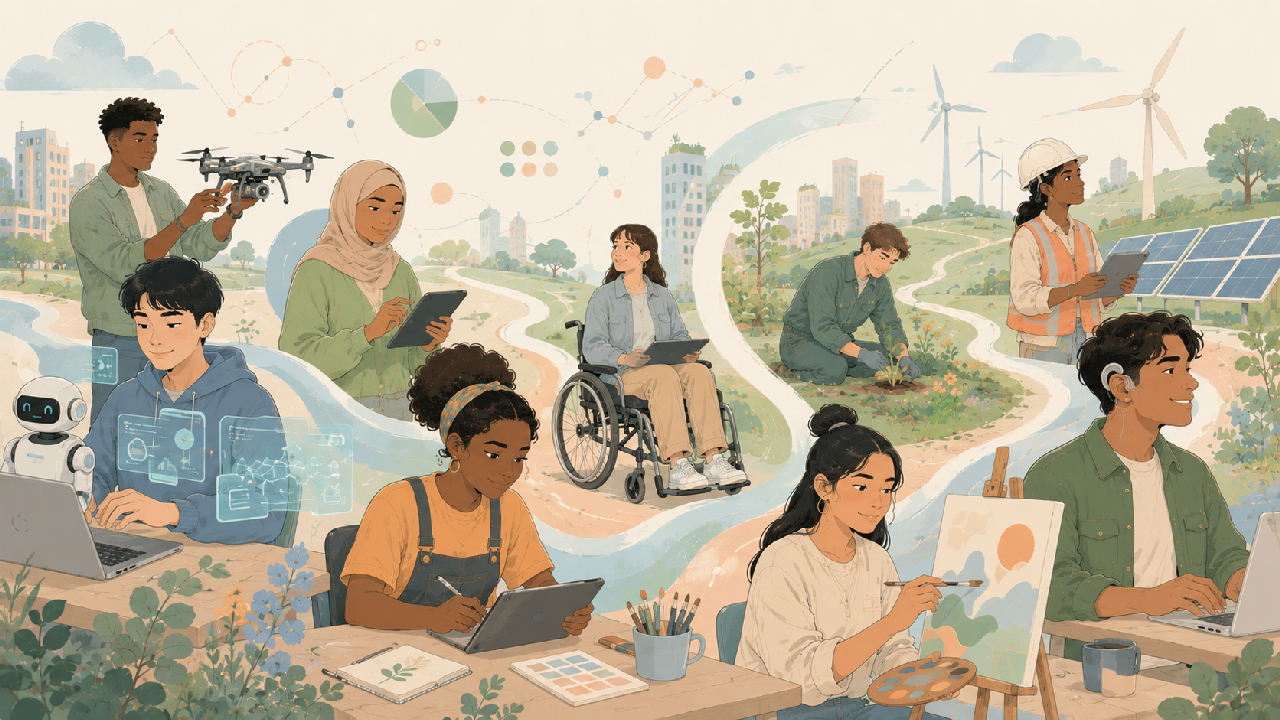
The strongest “tomorrow skills” tend to sit in three buckets:
- Tech and data skills (including AI tools)
- Green and sustainability skills (how we build, power, move, and reduce waste)
- Creative and communication skills (storytelling, design, content, and making ideas real)
Let’s start understanding what this means
Industry 1: AI is changing tasks inside jobs (not just creating new ones)
AI is not only a sector. It is becoming a layer across lots of work, from admin to marketing to healthcare.
The World Economic Forum’s Future of Jobs Report 2025 highlights that technology, AI, and automation are reshaping what employers need, and it lists skills that are rising in importance.
Skills to build (AI-adjacent, beginner-friendly)
- Analytical thinking (spot patterns, make sense of info)
- AI and data literacy (understand what AI can and cannot do)
- Creative thinking (generate options, not just answers)
- Resilience and adaptability (learn, test, improve)
Where to start (without overthinking it)
- Learn one AI tool for a real purpose (study help, CV-free portfolio, planning, content drafts)
- Build one small project you can show (a page, a plan, a poster, a simple website, a mini research summary)
- Practise “prompting” like a skill, then check the output critically
Industry 2: Green jobs are growing, and hiring is getting more skills-based
Green work is not just “working in nature”. It includes construction, engineering, transport, logistics, manufacturing, utilities, and local services.
LinkedIn’s Economic Graph report on Skills-Based Hiring (March 2025) is useful here because it focuses on fast-evolving areas like Green jobs and AI jobs, and it supports the idea that employers are increasingly looking at what you can do, not only what you have on paper.
Skills to build (green and practical)
- Systems thinking (how parts connect, how to reduce waste)
- Safety and compliance basics (depending on the route)
- Problem solving (fix, improve, maintain)
- Teamwork and reliability (huge in real workplaces)
Where to start
- Look for local training routes that lead to recognised certificates
- Start with “adjacent” roles that get you into the sector (operations, admin, site support), then specialise
Industry 3: Creative industries are big, but the route in can be confusing
Creative is not a hobby sector. It is a major part of the UK economy.
A UK Parliament House of Lords Library briefing (Feb 2025) reports:
- £124bn creative industries GVA in 2023 (about 5.2% of total UK GVA)
- 2.4 million jobs in creative industries in 2023–24 (about 7% of all filled UK jobs)
- 28% of creative jobs are self-employed (vs 14% across all UK jobs)
That last point matters. Creative careers often look like:
- Freelance and short projects
- Portfolio careers
- Side-by-side roles (part-time job plus creative work)
So the pathway can feel messy, even when the sector is strong.
Creative PEC’s report on Skills mismatches in the UK’s Creative Industries (Feb 2025) backs up the idea that there are skills gaps and mismatches. In plain terms, it means there is opportunity, but the route from “I’m interested” to “I’m employable” is not always clearly signposted.
Skills to build (creative that employers pay for)
- Communication (explain ideas clearly)
- Design and storytelling (make things people understand and want)
- Digital making (video, editing, design tools, basic web)
- Client skills (briefs, feedback, deadlines)
Where to start
- Build a small portfolio of proof (3–5 pieces is enough to begin)
- Learn one tool properly (editing, design, 3D, audio, writing)
- Practise shipping work, not waiting for perfect
A strengths-first way to choose your next step
If you feel overwhelmed, do not start with “what job should I do?”
Start with:
- 1.What do I want more of? (people, calm, creativity, outdoors, independence, structure)
- 2.What drains me? (chaos, constant talking, sitting still, pressure, conflict)
- 3.What strengths do I want to use daily? (curiosity, kindness, bravery, humour, teamwork, persistence)
- 4.What is one small experiment I can try this month?
You do not need certainty.
You need momentum.
Where inyourroots® fits
inyourroots® is building a strengths-first, CV-free career discovery journey to help you:
- Understand what you are good at, in plain language
- Explore fast-changing industries without pressure
- Turn strengths into options, and options into proof
- Find local routes into work, training, and apprenticeships
The future is not one door.
It is a path you build by taking the next step.
Sources
- NatCen, Mental health of children and young people: is it all doom and gloom? (money worry stat): https://natcen.ac.uk/mental-health-children-and-young-people-it-all-doom-and-gloom
- UK Parliament (House of Lords Library), Creative industries: Growth, jobs and productivity (Feb 2025): https://lordslibrary.parliament.uk/creative-industries-growth-jobs-and-productivity/
- LinkedIn Economic Graph, Skills-Based Hiring (March 2025): https://economicgraph.linkedin.com/content/dam/me/economicgraph/en-us/PDF/skills-based-hiring-march-2025.pdf
- World Economic Forum, Future of Jobs Report 2025: https://reports.weforum.org/docs/WEF_Future_of_Jobs_Report_2025.pdf
- Creative PEC, Skills mismatches in the UK’s Creative Industries (Feb 2025): https://pec.ac.uk/wp-content/uploads/2025/02/Creative-PEC-Skills-mismatches-in-the-UKs-Creative-Industries-12-Feb-2025.pdf