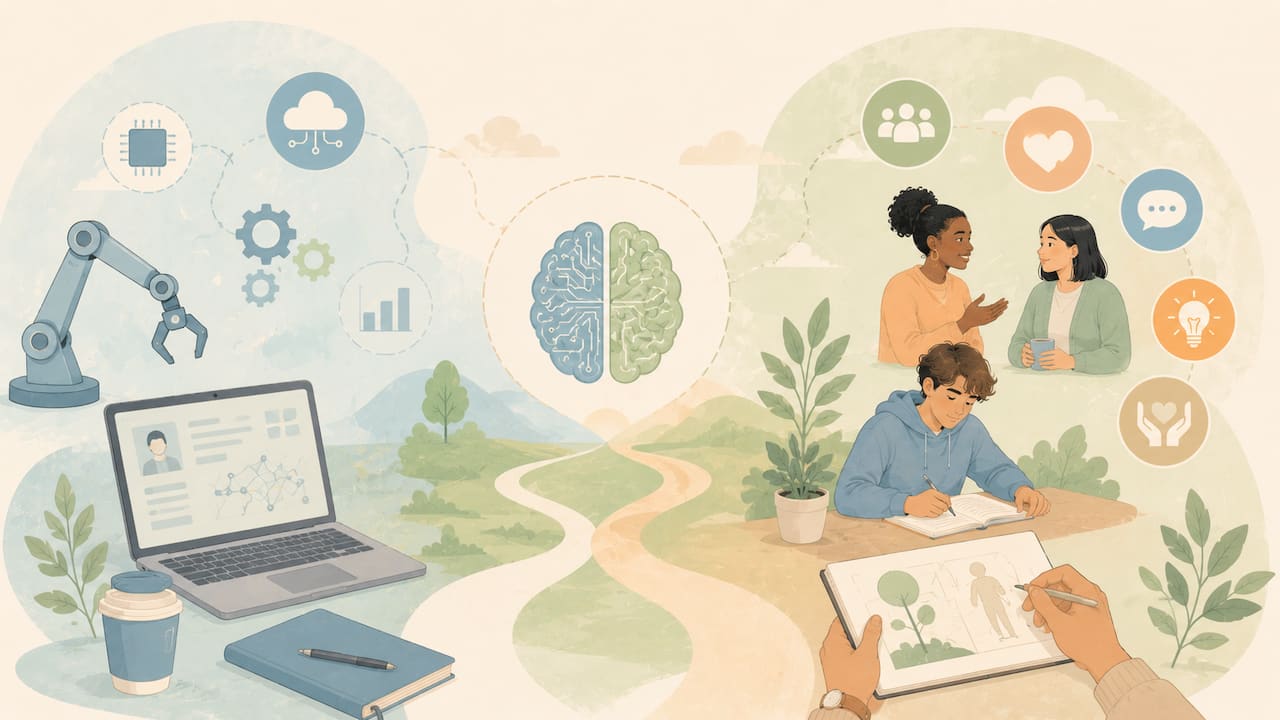
AI and jobs in the UK, what changes, what stays human
AI is changing work, but it is not a simple story of “jobs disappearing”. This evidence-led guide explains what is most likely to change, where entry-level roles feel the squeeze, and what stays human. It also shares practical next steps for young people, SMEs, and families, safely and fairly.
Written by: inyourroots® Research Team
AI is changing work, but it is not a simple story of “jobs disappearing”. Most change happens task by task.
AI is changing work. That is real.
But the most useful question is not “Will AI take all the jobs?”
It is: What tasks will change, what new work will appear, and what stays human, especially for people trying to get their first chance?
This page is designed to be evidence-led, practical, and clear.
The balanced view: opportunity and risk
AI can:
- remove repetitive admin
- speed up drafting and research
- support learning and practice
- help small teams do more
AI can also:
- make hiring more automated and less transparent
- increase scams and impersonation
- widen gaps if access and guidance are unequal
Both can be true at the same time.
Task change vs job loss (what’s most likely)
Most credible research focuses on tasks changing before whole jobs disappear.
That means:
- some parts of many roles will be automated
- new tasks will appear (checking, improving, and safely using AI outputs)
- people who can combine human judgement with tools will move faster
For entry-level work, the risk is not only job loss.
It is the “first rung” getting harder to reach if employers expect candidates to arrive fully formed.
Entry-level work: where the squeeze shows up
- fewer junior tasks available (because tools do them)
- higher expectations for speed and output
- more automated screening and keyword filtering
- less feedback, and more ghosting
This is why strengths-first routes matter. They help people show potential when old signals are missing.
Fairness, bias, and accountability in hiring
If AI is used in recruitment, fairness depends on three things:
- Transparency: can a candidate understand what is being assessed?
- Accountability: is a human responsible for the decision?
- Accessibility: can first-timers and neurodivergent candidates engage without being excluded?
Simple principle: AI can support decisions, but it should not be the decision-maker.
Privacy and safeguarding (especially for young people)
AI changes the risk landscape:
- job scams can look more convincing
- deepfakes can be used to impersonate employers
- personal data can be harvested through fake applications
Families, schools, and employers need clearer checks, not more panic.
Practical next steps (by audience)
If you’re 16–25
- build proof of human skills (communication, reliability, problem-solving)
- learn to use AI tools safely, not secretly
- practise interviews and workplace confidence
If you’re a parent or educator
- talk about scams without shame
- help them check roles before applying
- keep routines steady while confidence rebuilds
If you’re an SME
- use AI to reduce admin, not to filter out first-timers
- keep a human step in every decision
- design a fair first step that does not rely on perfect CVs
A good default
Make the next step smaller, clearer, and more human.
Sources
- https://www.pwc.co.uk/economic-services/assets/macroeconomic-impact-of-ai-uk.pdf
- https://www.ons.gov.uk/employmentandlabourmarket/peopleinwork/employmentandemployeetypes/bulletins/uklabourmarket/latest
- https://www.gov.uk/government/publications/ai-regulation-a-pro-innovation-approach
- https://www.gov.uk/government/collections/ai-safety-summit
- https://www.oecd.org/ai/