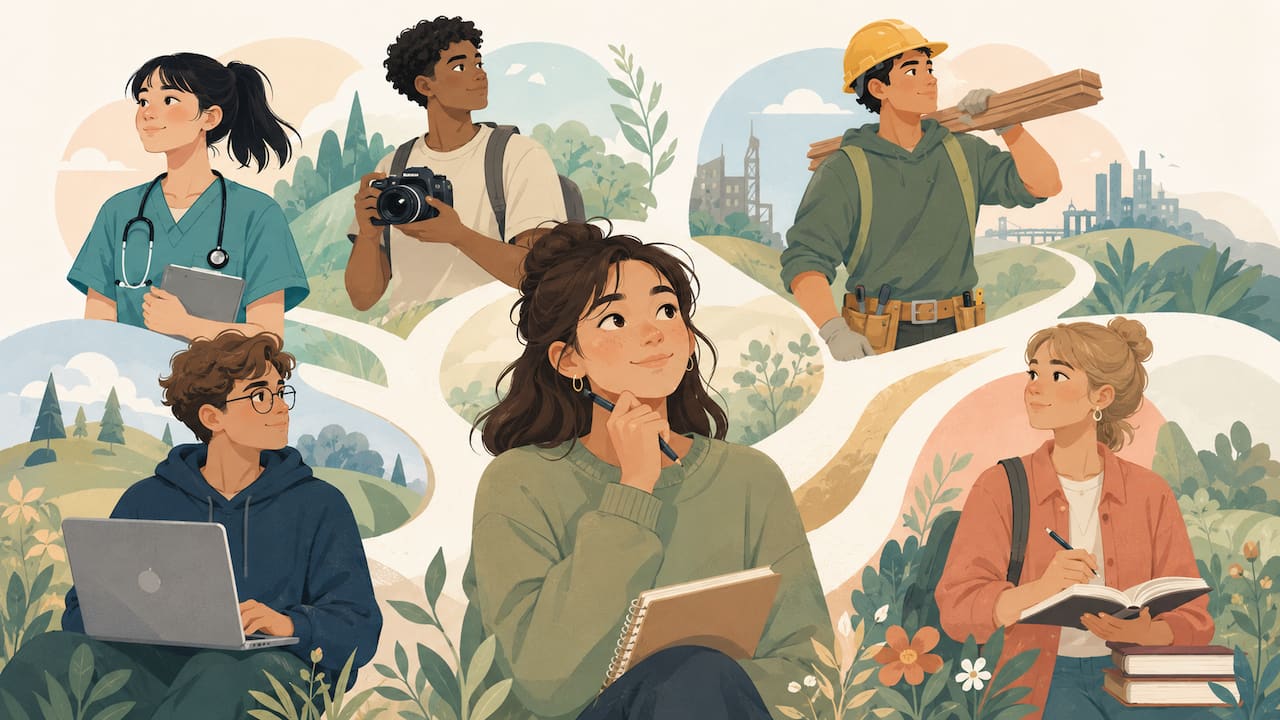
If your answer is “I don’t know”, you’re not behind. You’re just being honest.
A lot of young people are expected to pick a path early, subjects, college, apprenticeships, uni, jobs, like there’s one “right” route and you’re supposed to know it already. But real life doesn’t work like that.
Especially if you’re neurodivergent, anxious, caring for someone, juggling work, or you’ve just never had the chance to explore what you’re actually good at.
This is your reminder: you’re allowed to figure it out. And if you’re asking yourself “what job should I do?” or “what career is right for me?”, you’re asking the right questions. You’re just asking them at your own pace.
Find your people: what does “enjoy” even mean?
Enjoy doesn’t have to mean “I wake up buzzing every day”. Sometimes it means:
- You feel calmer doing it than you expected
- Time goes quicker
- You don’t have to force yourself to start
- You feel proud after (even if it was hard)
- You like the people, the vibe, or the purpose
And sometimes you don’t enjoy something, but you’re doing it because it feels safe, expected, or like the only option. That’s not a failure. It’s a signal.
The real clue is this: what kind of people and environments make you feel safe, capable, and energised?
Because that’s how you spot work that actually fits. Not work that looks good on paper, but work where you can be yourself and do your best.
Your people might be…
- A small, tight-knit team where everyone knows your name
- A busy, buzzy environment where you feed off the energy
- Quiet, focused spaces where you can concentrate
- People who share your values or sense of humour
- A mix of mentors, peers, and people you’re helping
Notice what you’re drawn to. That’s data about what kind of workplace culture suits you.
Signs you’re ready to explore (permission to start)
You don’t need to have it all figured out. You don’t need a perfect CV, work experience, or a five-year plan.
Here are the real signs you’re ready to explore:
- You’ve noticed something you’re curious about (even if it’s small)
- You’re tired of not knowing and want to take a step
- You’ve got a few hours a month to try something new
- You’re willing to ask questions and learn as you go
- You’re okay with not being perfect at something yet
Exploring isn’t committing. It’s learning.
Find your pace: 5 questions to help you spot what fits
You don’t need a perfect plan. You just need a few clues.
- What do people come to you for? (Explaining things, fixing stuff, calming people down, organising, making things look good)
- What do you do when no one’s watching? (Gaming, editing videos, drawing, helping siblings, researching random topics, building things)
- What drains you fast? (Noise, pressure, being watched, too many instructions, constant change)
- What makes you feel useful? (Helping, creating, solving, leading, supporting, improving)
- What kind of day could you handle most days? (Indoors/outdoors, people/quiet, routine/variety, hands-on/desk-based)
- Write your answers down, even messy. Even one word each. That’s data.
Find your path: start with strengths, not job titles
Job titles can feel overwhelming because they’re vague and they change all the time. Strengths are clearer. They’re the things you naturally bring, even when you’re not trying.
Examples of strengths that can shape a path
- Good at noticing details (quality control, design, research, healthcare)
- Good at reading people (mentoring, customer service, counselling, teaching)
- Calm in a crisis (emergency services, healthcare, support roles, leadership)
- Curious and quick to learn (tech, research, training, project management)
- Great at making things simpler (user experience, writing, teaching, operations)
- Creative with limited resources (entrepreneurship, social enterprise, design, problem-solving)
Those strengths can grow into loads of different paths, and you don’t have to pick just one right now.
The point is: start by noticing what you’re naturally good at, then explore where those strengths take you.
Why strengths-first matters (especially if you don’t fit the mould)
Traditional career advice often assumes you’ve got work experience, good grades, or a clear sense of direction.
But loads of young people don’t fit that box, and that’s not a problem with you. It’s a problem with the system.
If you’re neurodivergent, you might be brilliant at pattern-spotting, creative thinking, or hyperfocusing on things you care about, but traditional interviews or CVs don’t show that.
If you’ve been caring for someone, dealing with anxiety, or just haven’t had the chance to explore, you might have skills you haven’t named yet.
Strengths-first exploration works differently. It says: “What are you actually good at, right now, in your own way?” Not “What does your CV say?”
That’s why it works for people who’ve felt overlooked by traditional systems.
You don’t need a CV to start exploring
You can explore careers without having “experience”. You can:
Small experiments that count
- Try a short volunteering shift
- Do a one-day shadowing visit
- Message a local business and ask 3 questions
- Watch “day in the life” videos and notice what you don’t like
- Build a tiny portfolio (photos, designs, a playlist of edits, a mini project)
Small experiments count. They’re how you learn. And they’re how you build real confidence, not the fake kind, but the kind that comes from actually trying something.
A gentle challenge (10 minutes)
Pick one of these and do it today:
- Make a list of 3 moments this week where you felt “that wasn’t too bad actually”
- Ask a friend: “What do you think I’m good at?”
- Google: “Jobs for people who like ___” and fill in something real (animals, fixing things, organising, being outdoors)
- Write down one thing you want more of in your future (freedom, stability, creativity, helping people, money, purpose)
That’s it. No pressure.
What happens next?
Once you’ve spotted a few clues about your strengths and the kind of environment where you thrive, the next step is to explore what that actually looks like in your area.
What industries are hiring? What roles match your strengths? Who’s doing work that feels meaningful to you?
That’s where the real discovery starts, and it doesn’t have to be complicated. It’s just noticing patterns, asking questions, and taking small steps forward.
Where inyourroots® comes in
inyourroots® is building a strengths-first career discovery experience for young people aged 16–25. Especially if you’ve felt overlooked by traditional systems.
No judgement. No “perfect” answers. Just a supportive journey that helps you:
- Spot your strengths
- Explore local industries and roles
- Build confidence step-by-step
- Connect with real opportunities in your area
- Find your pace, find your people, find your path
If you’re ready for a next step, Budi can guide you through the inyourroots® career discovery experience, at your pace.
No rush. No pressure. Just you, your strengths, and the support you need to move forward.
Join the waitlist at inyourroots.com/budi